

With immersive gameplay, smart streaming, adaptive triggers, and more, technological advancements have made modern gaming console platforms appear unrecognizable from their early iterations, which date back to the early 1970s.
It is almost hard to believe that the Atari 2600 and Intellivision would have led to the Nintendo Switch 2 and PlayStation 5 Pro, as consoles have evolved from bulky devices requiring endless cables and cartridges to multimedia mega-machines where gaming can almost feel secondary to the vast number of features.
But as the technology that powers these consoles has rapidly developed over the decades, you’d expect that it’s hitting the spending power of consumers across the United States harder than ever, right?
Well, the answer might surprise you.
mBit Casino recently analyzed more than 50 games console releases dating back to 1977 right up to the modern day, to uncover the true cost of release day purchases and record auctions throughout the years.
The survey of 2,000 American consumers details their attitudes on the costs associated with buying games consoles, and how it has impacted their purchasing patterns.
The study reveals:
- 7 in 10 Americans (71%) believe that game consoles are too expensive, with over half (55%) revealing that the costs associated with consoles has resulted in them playing less over the last two years.
- Gamers in the 1970s and 1980s had to work the most hours to afford a brand-new gaming console.
- Whereas players in the 2010s had to work the least to earn a brand-new console on launch day.
- Since the release of the Atari 2600 in 1977, it has taken the average US consumer 9 hours of work to buy each console on release.
- The 1990 release of Neo Geo required 62.9 hours of work to purchase on launch day, the highest figure in the study.
- Whilst the Neo Geo Pocket Color (1999) required 5.1 hours, the lowest amount in the study.
- Nintendo’s recent releases appear to offer value for money for consumers, with the Nintendo Switch 2 (15 hours) and the Nintendo Switch OLED (14.1 hours) ranking both in the top 20 most affordable consoles upon release.
- The 2024 release of the PlayStation 5 Pro was one of the most expensive in history, requiring 24.5 hours of work to purchase on release, placing it 42nd out of 51.
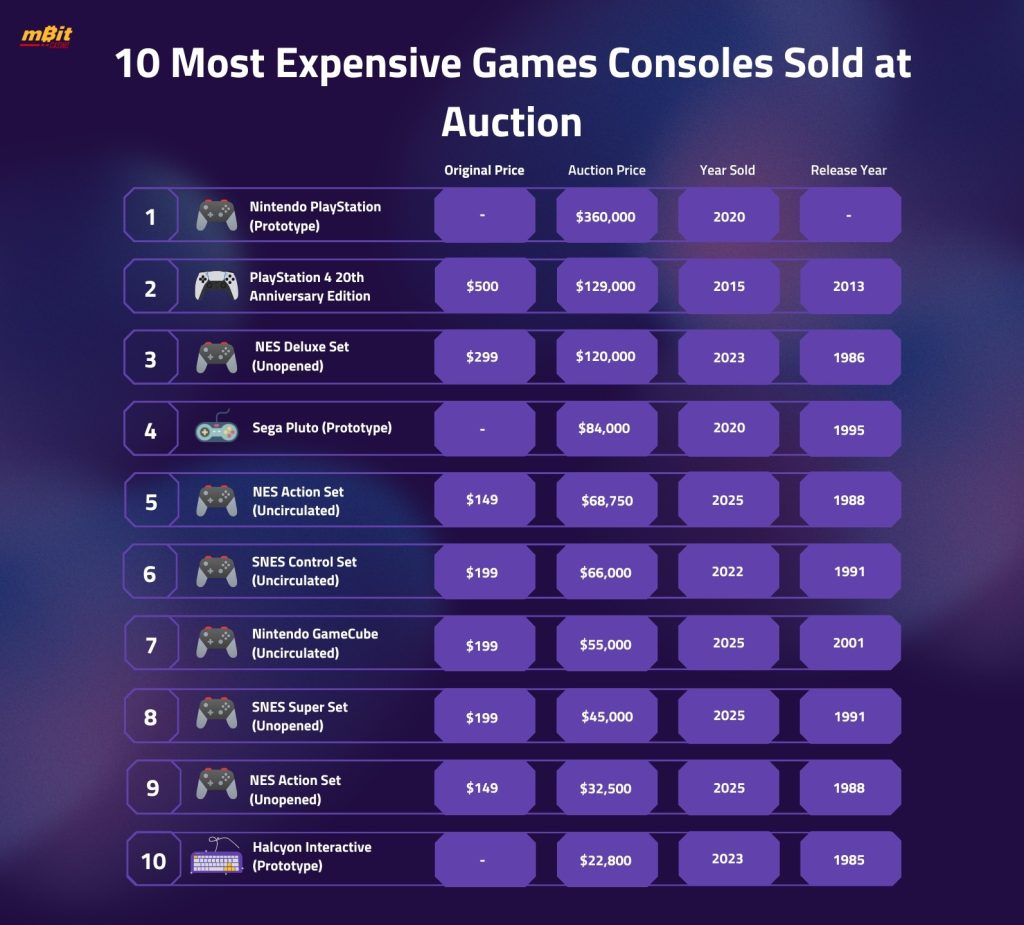
- Nintendo & PlayStation’s unreleased prototype is the most expensive console of all time, selling for $360,000 on auction in 2020 and earning a spot in the Guinness World Records.
7 in 10 US consumers believe gaming is too expensive in 2026, and it’s impacting both their playing and purchasing behavior
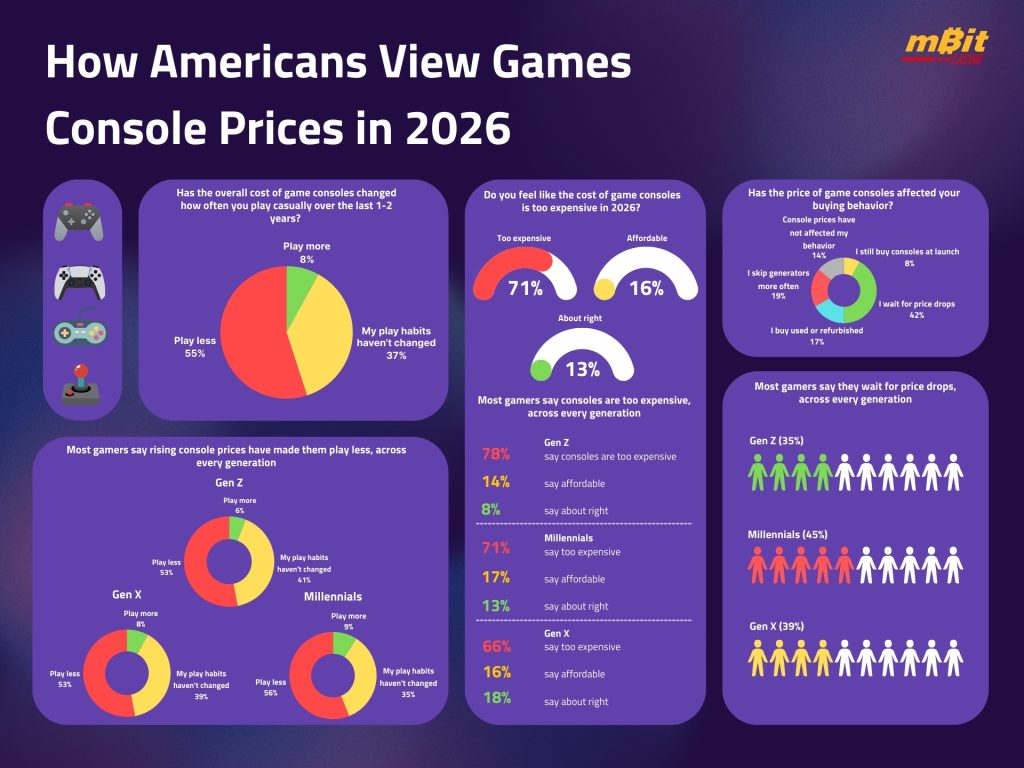
The American people have spoken, and they believe that prices are only going one way when it comes to gaming on consoles in 2026.
Respondents across all generations stated that consoles are too expensive, headlined by Gen Z, where almost eight in 10 (78%) believed this to be the case, followed by millennials (71%), while two thirds of Gen X respondents (66%) followed that viewpoint. However, almost two in 10 Gen X respondents (18%) stated they believed the costs of consoles were about right.
Despite this, over half of respondents in the study (55%) revealed that they have spent less time playing on consoles over the last two years, due to the expenses. An answer that was consistent across Gen Z (53%), Millennials (56%), and Gen X (53%). Only 8% of all survey respondents said that their playing habits had increased during that period.
This is further evidenced by consumer purchasing behavior, with more than four in 10 Americans surveyed (42%) revealing that they do not buy consoles upon release, instead they prefer to wait for price drops.
Almost a quarter of Gen Z (22%) participants revealed that they skip generations of consoles now, instead of upgrading immediately. For example, waiting until Nintendo Switch 2 has been released before purchasing a Nintendo Switch OLED. This is a habit adopted by also adopted by 20% of Millennials.
Whereas just 8% of Gen X revealed that they skip console generations, with a study-high 16% stating that they still buy consoles upon launch.
$1,000+ for a game console? The inflation-adjusted reality that 80s & 90s gamers faced
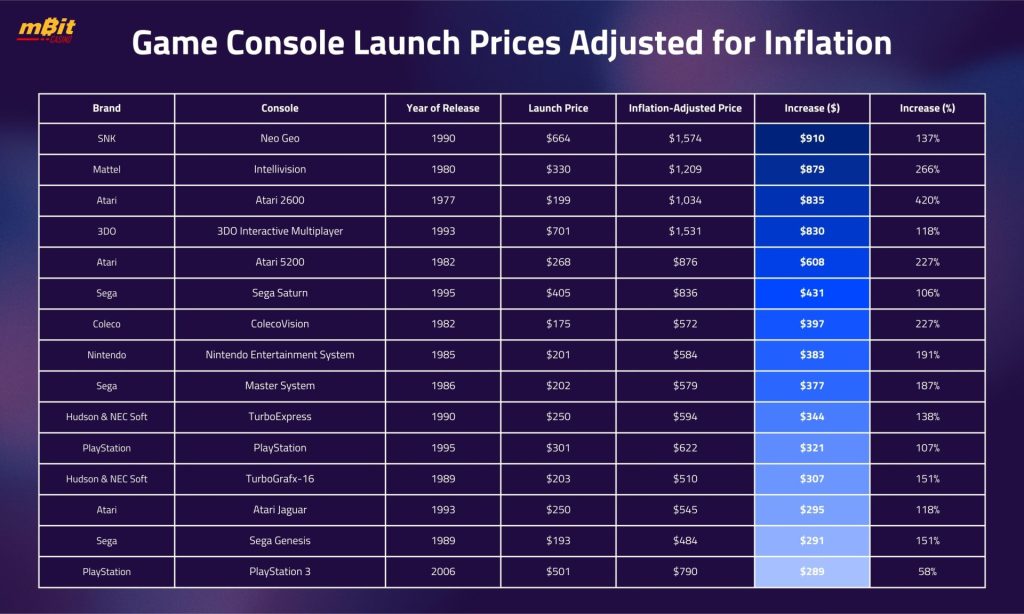
Console releases have come under huge scrutiny in recent years due to the significant financial outlays that fans face on launch day. The most recent high-profile releases come in the form of the Nintendo Switch 2 (2025) and PlayStation 5 Pro (2024), which hit retailers at $449 & $699, respectively.
Whilst the announcement of modern-day releases creates plenty of headlines, casting our eye back to the 70s-90s can paint a slightly different picture.
Gamers wanting to get their hands on innovative technology such as the Atari 2600 (1977, $199), Intellivision (1980, $330), and the Atari 5200 (1982, $268), faced huge costs which may appear small in comparison to the modern day.
However, with those prices adjusted for inflation, it shows just how expensive these pieces of tech were at the time. Gamers would’ve been faced with huge bills of $1,034 for the Atari 2600 (+420%), $1,209 for the Intellivision (+266%) and $876 for the Atari 5200 (+227%).
The study revealed the 1990-released SNK’s Neo Geo to be the console that has seen the biggest inflation-related jump. Originally retailing for $664, a total only surpassed by the 3DO Interactive Multiplayer in the 90s ($701), sees the Neo Geo’s price surge by +137% to $1,574 when adjusted for inflation in the modern day.
But even with inflation factored in, there’s still some retro gaming classics that provide value for money.
The 80s-00s were dominated by the Game Boy, with the 1998 release of the Game Boy Color retailing at just $69, which comes in at a relatively affordable $134 (+94%) when adjusted for inflation.
US Gamers in the 2010s had to work the fewest hours to earn a brand-new console, whilst those in the 70s & 80s worked the most
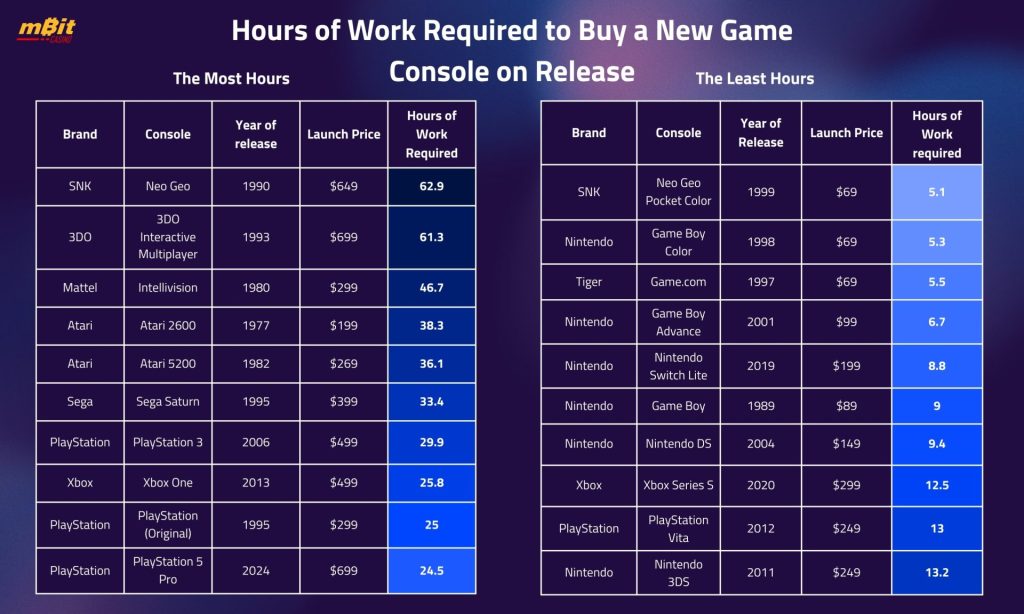
7 in 10 Americans surveyed revealed that the cost of purchasing game consoles on launch is impacting their gaming behavior in 2026. However, median salary figures reveal that gamers in the 70s & 80s had to work the most hours to purchase their favorite console on its opening day of sales.
There were 11 releases during that time period, which equated to an average of 24.8 hours of work to buy on launch. This was closely followed by the 90s (22.5 hours), while the 2020s sits in the middle of the pack (17.6). The 2010s required the fewest hours of work at 16.2, just ahead of the 00s (16.8).
The consoles that required the fewest hours of work to purchase on release all came out in a three-year period in the 1990s. This included the Neo Geo Pocket Color (1999, 5.1 hours), Game Boy Color (1998, 5.3 hours) and Tiger’s Game.com (1997, 5.5 hours).
Nintendo dominates the top 10 most affordable consoles with five more iconic gaming systems, emphasizing the huge popularity of their handheld releases throughout the 90s & 00s. This includes retro classics such as the Game Boy Advance (4th, 2001, 6.7 hours) and the Game Boy (6th, 1989, 9 hours).
Their newest title, the Nintendo Switch 2, created plenty of headlines when it was announced to retail for $449, a whole $150 more than the first iteration of the console, which ranks 18th overall for hours required to buy (15), with the original Switch ranking 13th (13.8 hours).
PlayStation’s last major release, the 5 Pro, ranks 42nd out of 51, with its hefty $699 price tag taking over 24 hours of work.
At the foot of the rankings is the Neo Geo. This was the second-most expensive release of the 90s at $649, which in turn resulted in almost 63 hours of work required to purchase it on the opening day. The only console to cost more in the 90s was the 3DO Interactive Multiplayer ($699), which ranked 50th out of 51 for hours of work needed to buy (61.3).
One-of-a-kind prototypes and unopened relics, the consoles that auction for tens of thousands of dollars
The console market is lucrative for manufacturers when launching new products, but that is also the case for re-sellers and retro gaming collectors.
Unopened consoles from the 70s – 90s have auctioned for tens of thousands of dollars over the last 40 years, way surpassing their original MSRP (manufacturer’s suggested retail price).
The most expensive came in 2020, with the unreleased Nintendo PlayStation prototype fetching a staggering $360,000 at Heritage Auctions. This was one of just 200 prototypes created in a joint venture between Sony and Nintendo. The sheer scale of the fee secured the prototype a place in the Guinness World Records as the most expensive video game console ever sold at an online auction.
Another Sony console features in second position, with the PlayStation 4 20th Anniversary Edition earning one seller $129,000 in 2015 via Yahoo! Auctions in Japan. Only 12,300 of these consoles have ever been produced, but the one in question was the very first unit, making it a unique collector’s item.
Rounding off the top three is the Nintendo Entertainment System (NES) Deluxe Set. Sold on Heritage Auctions, this winning bid came in at $120,000, not bad for a piece of tech that was initially launched 40 years ago (1986). As part of the Deluxe Set bundle, this included the unique R.O.B (robotic operating buddy) and a Zapper (plug-in video gun).
Methodology
- The full findings from the study can be found here.
- The study aimed to shine a light on consumer attitudes towards the cost of gaming in 2026 – revealing how prices over the years have impacted their purchasing power alongside median hourly salaries, and how lucrative re-selling can prove to be.
- To uncover attitudes to game console prices across the United States, we conducted a nationwide survey of 2000 respondents in January 2026 in collaboration with OnePulse.
- The survey’s demographics highlighted age (21+) and gender, with each respondent citing an interest in video games. This ensured a comprehensive understanding of views on gaming across different generations.
- To analyze the data, we grouped responses by age group, generation (Baby Boomer, Gen X, Millennial), and gender. The survey respondents included 59% males and 41% females. The average age of the respondents was 39 years.
- The inflation across console releases since 1977 was sourced from Inflation Station.
- To calculate how many hours it would take the average American to purchase each console on release, we sourced median weekly salary data from the Federal Reserve Bank of St. Louis which was then divided by 40 to determine the median hourly wage. This total was then divided by each console’s MSRRP to determine the hours of work required to be purchased.
- To determine the consoles that resold for the most money, we sourced data from Heritage Auctions, Wall Street Journal, CNet and the Guinness World Records to determine a definitive top 10.
Sources
Survey:
- Conducted by OnePulse
Console inflation:
- Inflation Station
Record consoles sales:
- Wall Street Journal
- Guinness World Records
- Heritage Auctions
- CNet
US median salaries:
- Federal Reserve Bank of St. Louis