

Jackpots & Germs: What’s really hiding on casino surfaces?
Have you ever thought about how many germs could be hiding in plain sight at the casino?
With crowded indoor spaces, high-touch surfaces, food and drink, and long operating hours, casinos can create the perfect environment for microbes to spread.
Footfall across these venues is huge. Over 130 million people visited a casino in the United States in 2025 [1], all in the hope of picking up a big win. But could they actually be dealt a bad — even gross — hand instead, contaminated by bacteria such as E. coli?
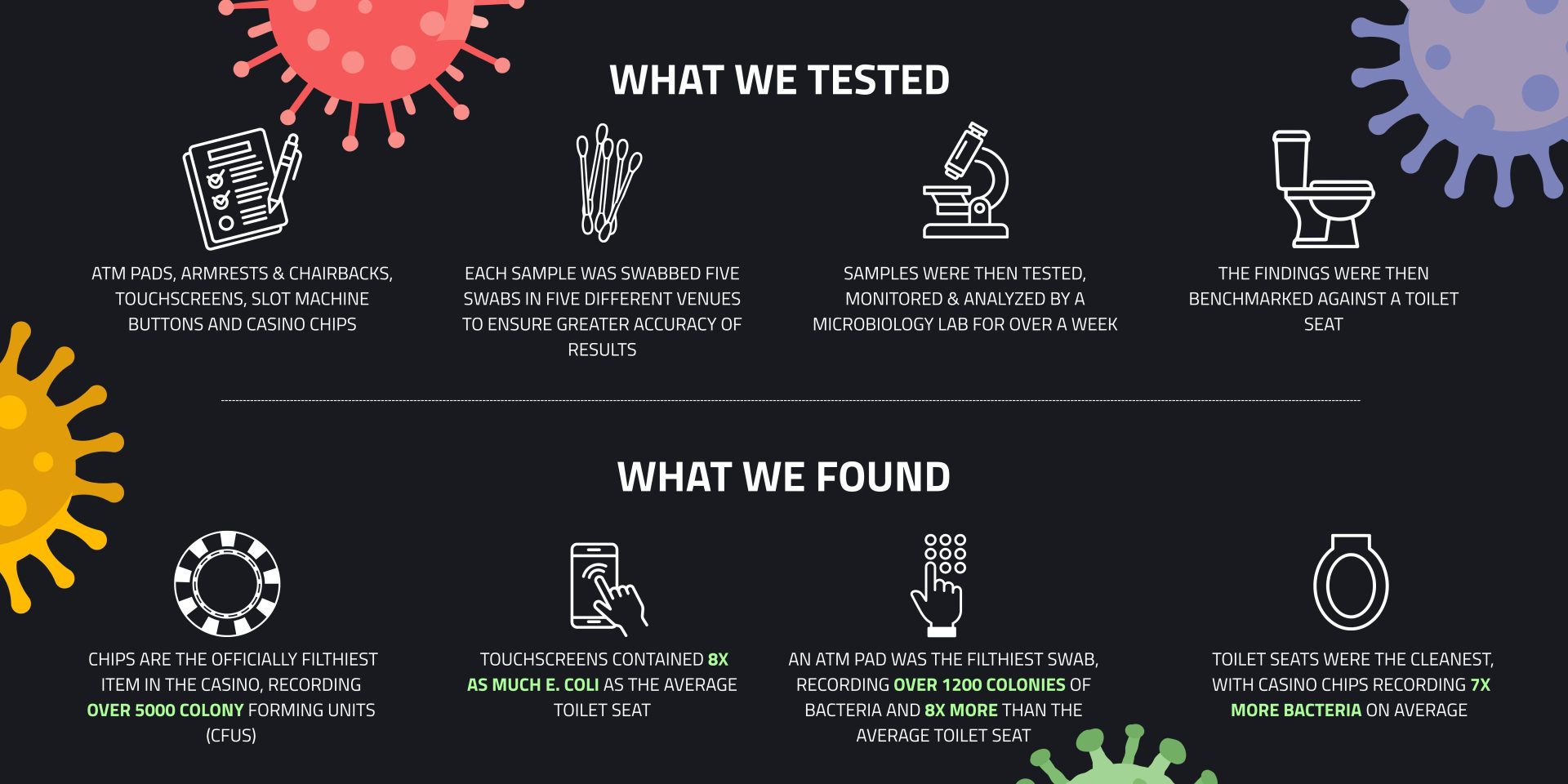
To find out, the team at mBit Casino partnered with microbiologists at BioLabTests to roll the dice on a filthy experiment. They analyzed five commonly handled items across five venues, with results benchmarked against a toilet seat. It is safe to say that the findings were gut-wrenching.
What the experts say
“The results show that high-touch casino surfaces can harbor significant levels of bacteria and fungi, significantly exceeding those found on toilet seats. This highlights how frequent human contact, combined with inconsistent hygiene practices, drives the spread of microorganisms across shared environments.”
“Surfaces that we assume are dirtiest, like toilet seats, are often cleaner because they are cleaned more regularly, while high touch/high traffic items accumulate more microorganisms due to constant handling and less frequent cleaning.”
“The presence of E. coli on multiple common surfaces further suggests that poor hand hygiene plays a critical role in contamination.”
“Overall, the findings demonstrate that everyday contact surfaces in casinos can act as major reservoirs for microbial transmission.”
Reynold Mpofu, Microbiologist at BioLabTests
Our experiment reveals chips are the filthiest item in the casino
One of the most handled items in the casino, and now officially crowned the filthiest.
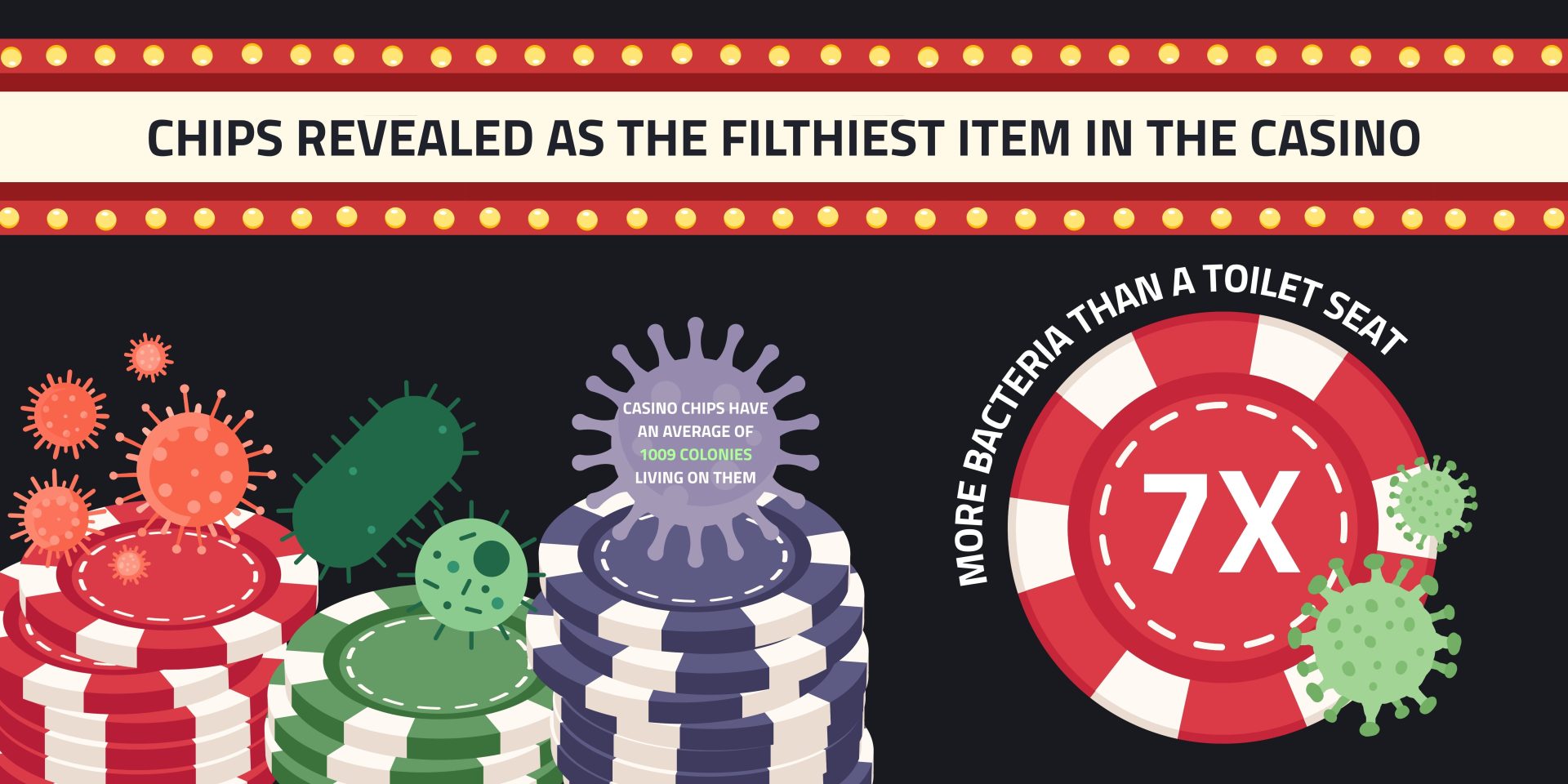
Chips were by far the most bacteria-ridden items in the experiment, averaging over 1,000 colonies of bacteria, and a whopping 7x more than the average toilet seat.
They also contained the most Staphylococcus spp. (a bacteria which can result in boils and skin irritation) with three of the five swabs maxing the detection limit. Grim stuff!
There’s estimated to be around 1,011 casinos across 46 States [3], which means a lot of chips. So, make sure to wash your hands before trying your luck!
Keep that sanitizer close! Thousands of bacteria colonies are hiding in plain sight in the casino
So how many germs could you encounter when you visit the casino? The answer, tens of thousands.
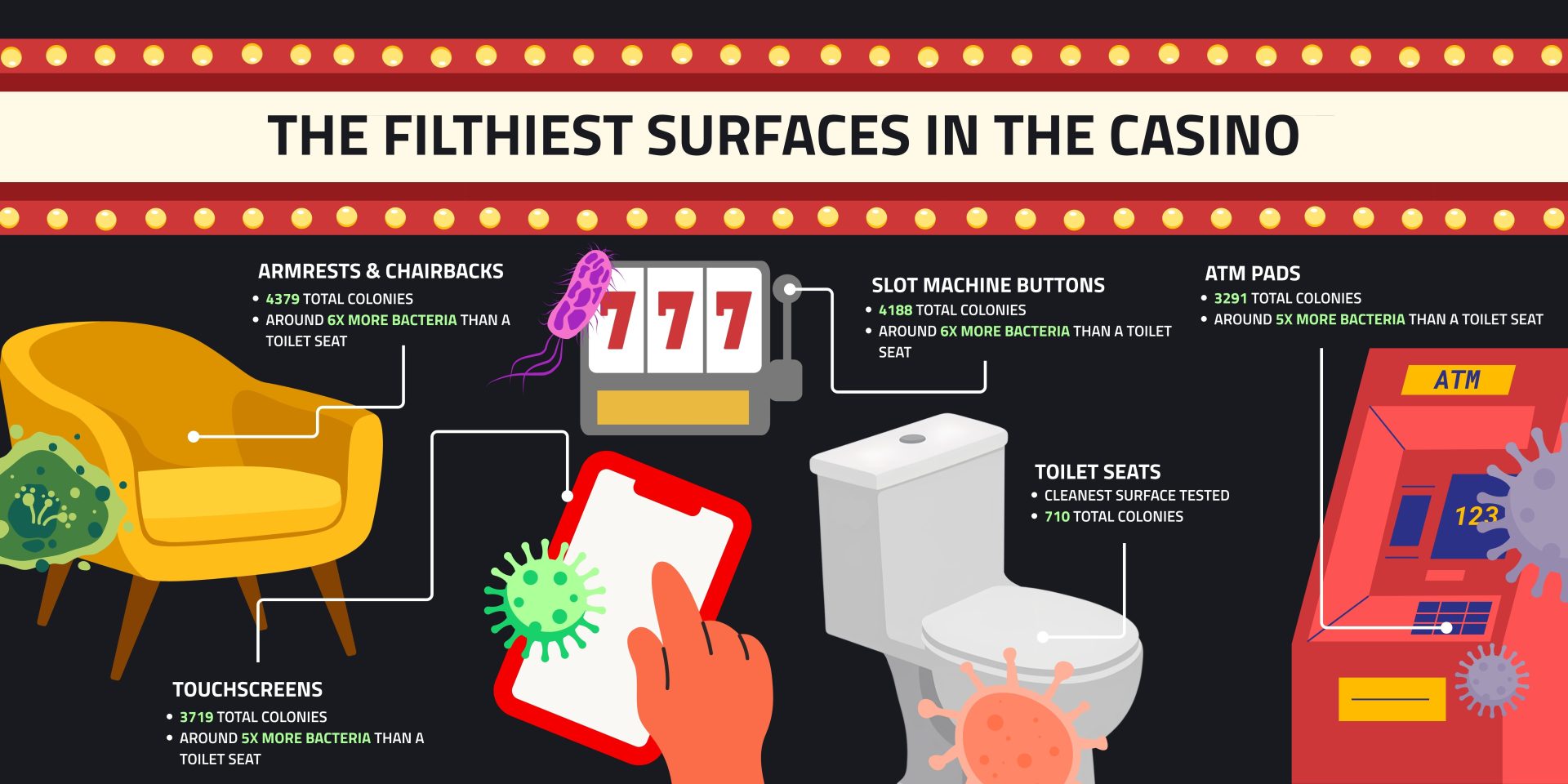
The experiment revealed that casinos are a hotbed for bacteria not just to spread, but to thrive. Each item returned thousands of colonies, ranging from 5x to 7x that of the average toilet seat.
Casino chips were by far the filthiest item in the casino, but armrests & chairbacks ranked second, registering the most yeast & molds, with three out of five samples maxing detection limits and registering 6x more than toilet seats.
The cleanest surface, by some distance, was toilet seats. These samples registered an average of 142 colonies and 710 in total, dwarfed by every other surface in the experiment.
It is estimated that over 38m people visited Las Vegas in 2025 [2], our advice to future travelers would be to pack hand sanitizer next time you head to Sin City!
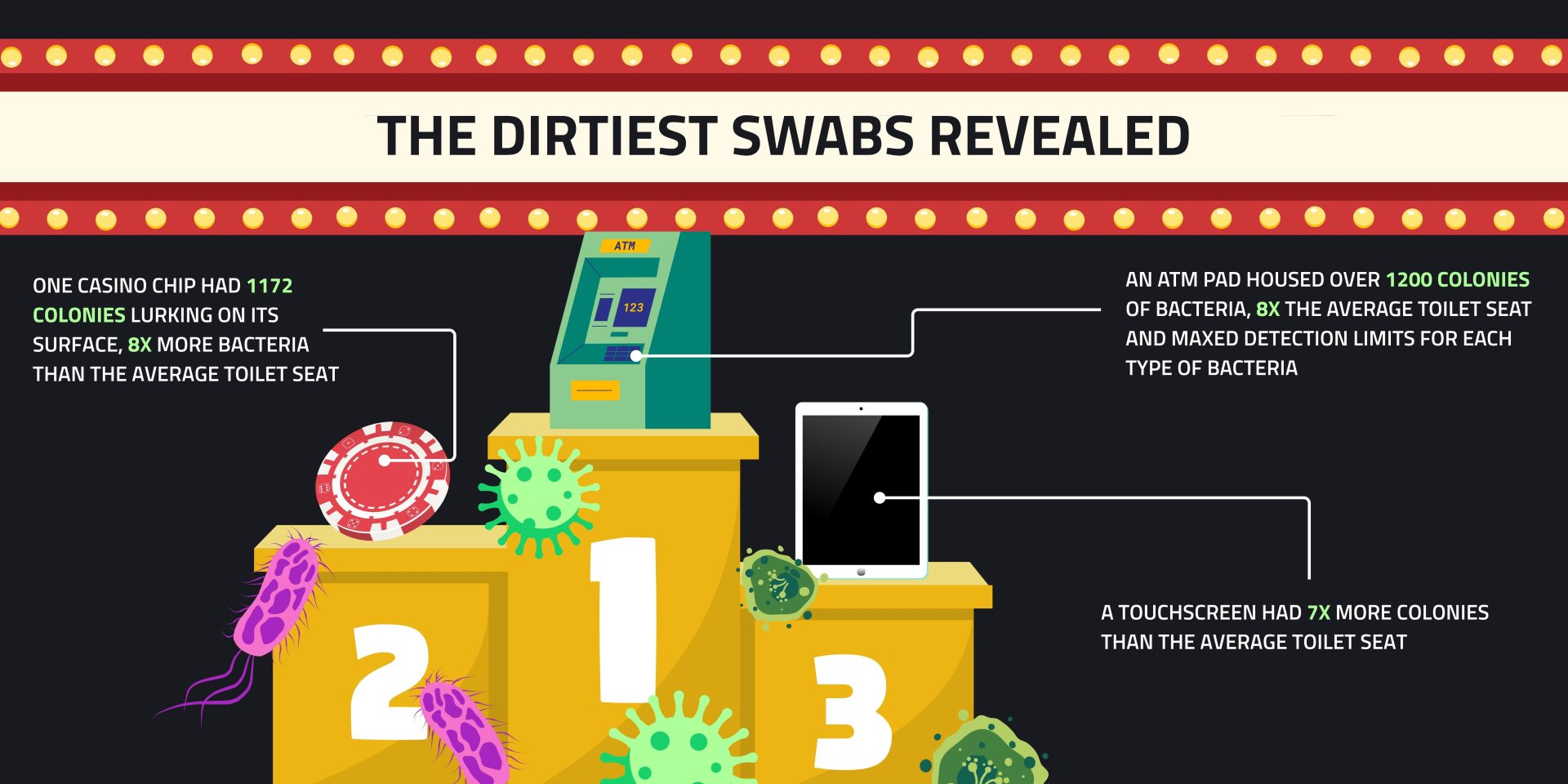
But an item that millions of Americans touch every day produced the dirtiest swab
Despite chips being by far the filthiest item in the casino on average, it was an item many of us use every day that was the dirtiest individual sample in the study. An ATM number pad.
ATM pads produce some of the highest levels of finger contact in the casino, and one ATM pad in particular was the only swab in the study to completely max out detection limits (300 CFUs) for each type of bacteria we tested. It registered a minimum of 1,200 colonies. That’s a massive 8x more than the average toilet seat!
The second dirtiest swab came in the form of a chip, which maxed the detection limits for E. coli and yeast & molds. This swab returned a total of 1,172 colonies of bacteria, a huge 8x more than the average toilet seat.
A touchscreen claimed the bronze for the dirtiest swabs, also maxing the detection limits for both E. coli and yeast & molds. The total of 1,088 colonies made it 8x dirtier than a toilet seat and leaves us pondering. Should we be wearing gloves next time we’re in the casino?
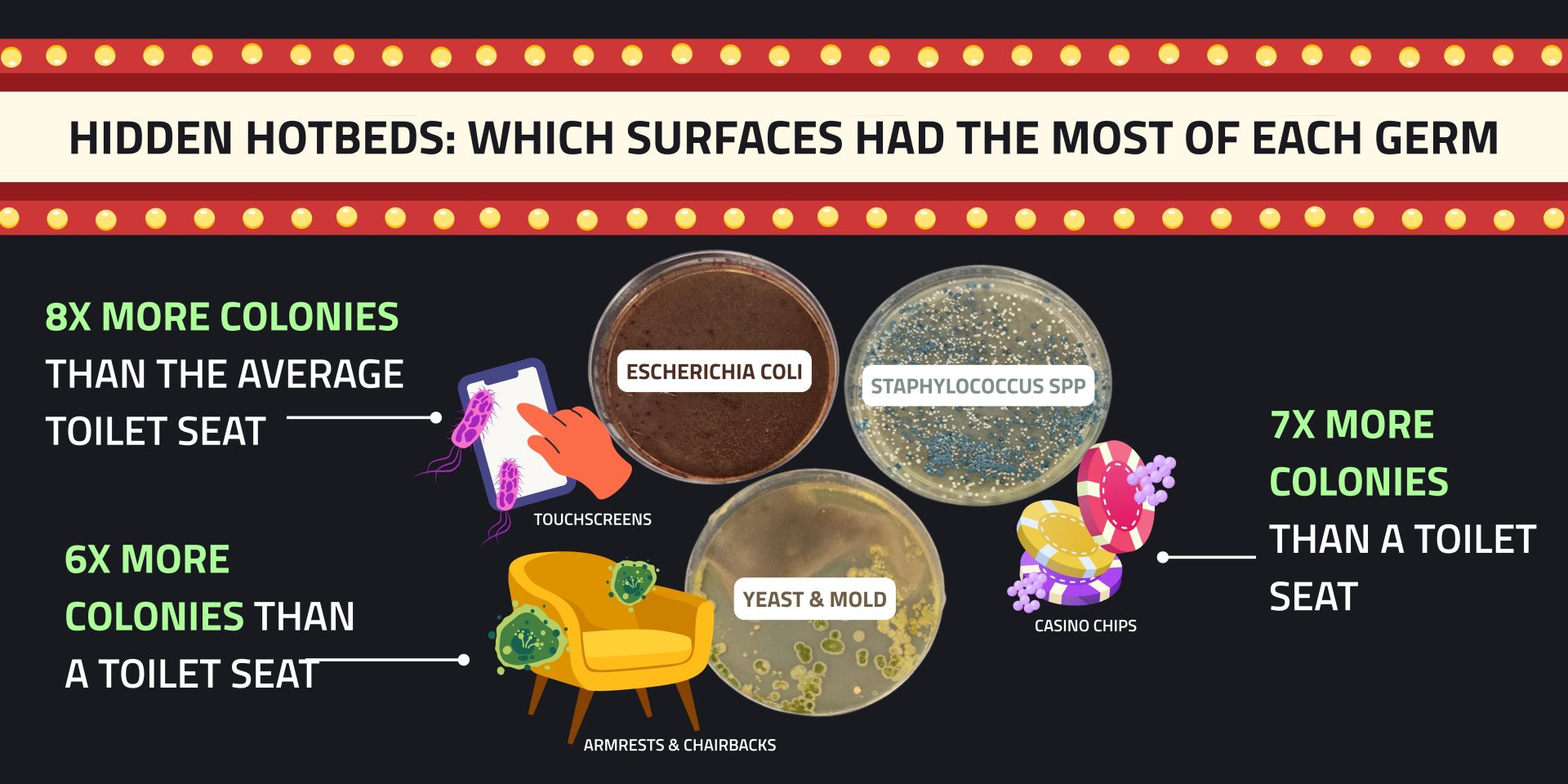
The findings reveal that each germ has its own favorite hotspot
We’ve revealed the quantity of bacteria hiding around the casino, but where were the bacterium hot beds? The answers make for unpleasant reading.
E. coli — Touchscreens
Touchscreens contained the most E. coli, with four out of five swabs maximizing detection limits (300+ colonies). These samples contained 8x more E. coli than the average toilet seat.
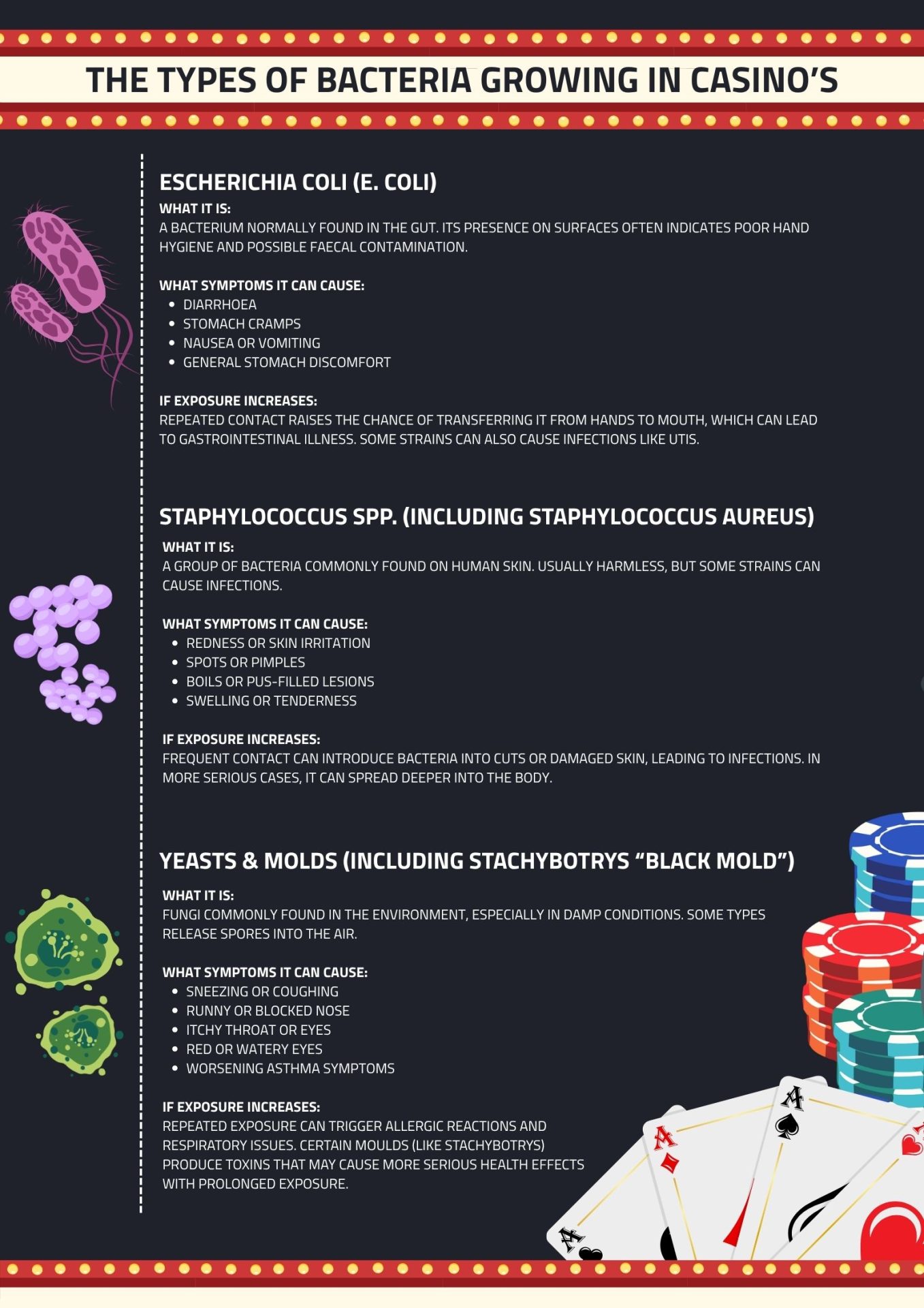
E. coli is a bacteria found in the gut, and contamination often indicates poor hand hygiene, usually after going to the toilet. Whilst some strains can be harmless, some can cause illnesses such as diarrhea, so it is very important to wash your hands if you think you may have encountered it.
Staphylococcus spp. — Chips
Staphylococcus is a bacterium that you have probably never heard of, but this study showed that it was rife within casino chip samples. Three swabs maxed out detection limits, racking up a total of 7x more than that of a toilet seat.
Staphylococcus is usually found on human skin, which can lead to skin infections, boils, and even abscesses. To combat any potential contamination, keep any cuts and wounds clean and covered, whilst regularly washing your hands.
Yeast & Molds — Armrests & chairbacks
The chairs that were swabbed in the study came in different shapes, sizes, and materials, but one core theme was shared between them all. Their agar plates showed that the chairs in casinos were swarming with yeast and mold colonies. Three samples maxed detection limits, and the total was 6x more than that of a toilet seat.
Thankfully, yeast & molds are generally harmless, however, exposure to spores can result in itchy throat or eyes, sneezing, coughing, and runny or blocked nose. Best practice to combat contamination includes good hand hygiene, avoiding touching your face after contact with high touch areas, and wearing a light mask in crowded areas.
How to avoid contamination in the casino, and best practice to avoid bringing germs home
The results make for shocking reading, but Reynold Mpofu, Microbiologist at BioLabTests, has provided helpful risk reduction tips to cover before, during and after a trip to the casino.
Before and during a visit to the casino
Cover cuts or broken skin
“Ensure any cuts, scratches, or abrasions are covered with a plaster. This reduces the risk of bacteria entering the body and causing infections.”
Avoid touching the face after handling shared items
“Try not to touch your eyes, nose, or mouth while playing. This is one of the main ways bacteria such as E. coli or Staphylococcus spp. can enter the body.”
Regular handwashing or use of hand sanitizer
“Clean your hands before consuming food or drinks. Avoid eating directly after handling chips or machines without sanitizing first.”
“Use hand sanitizer frequently, especially after handling high touch items like casino chips, slot machine buttons, or touchscreens.”
“Wipe down machines where possible. Use alcohol based disinfectant wipes on slot machines, buttons, and any screens before playing.”
Avoid placing personal items on surfaces
“Try not to place phones, bags, or drinks directly on shared surfaces like tables or machines. These items can pick up bacteria and transfer them later.”
Be cautious in restroom areas
“Wash hands thoroughly with soap and water after using the toilet. Use a paper towel (if available) to open doors or avoid direct contact with handles.”
How to reduce risk after visiting the casino
Sanitize personal items immediately
“Use sanitizing wipes on items that are used frequently during your visit, including your smartphone, wallet, keys, and cards.”
“Wipe down the exterior and interior of your handbag or bag with disinfectant to kill lingering microbes.”
Change and wash your clothes
“Once home, wash your hands thoroughly and consider changing clothes, especially after long periods in a high contact environment. This helps prevent transferring microorganisms onto household surfaces.”
“In addition, take off your clothes and put them directly in the washing machine, especially if you were in a smoking area.”
Use saline nasal spray
“Use a saline spray to rinse out dust and germs from your nose after the trip.”
Methodology & Sources
Full findings and agar plate images are available on request.
Overview
mBit Casino conducted a scientific experiment in partnership with microbiological testing experts, BioLabTests, to determine how much bacteria can be found inside the casino.
They identified five different areas and items that are commonly found in casinos, which were swabbed five times across five different venues, alongside a toilet seat for comparison:
- ATM number pads
- Armrests & chairbacks
- Casino chips
- Slot machine buttons
- Touchscreens
The testing was focused on a variety of different types of bacteria that were identified by BioLabTests before the experiment:
- Total Viable Count (TVC)
- Escherichia coli (E. coli)
- Staphylococcus spp. (including Staphylococcus aureus)
- Yeast & Molds (including Stachybotrys “black mold”)
Each sample collected across the five venues was swabbed in a 10cm x 10cm area where available, to provide greater consistency of results.
The Experiment
The experiment lasted a total of nine days, with the swabs placed in a temperature-controlled fridge (2–8°C) immediately upon return to the laboratory and analyzed within two hours to preserve viability.
The swabs containing neutralizing buffer were vortexed thoroughly for 10 seconds to disperse any bacteria present into the suspension. 100µl of suspension was pipetted aseptically using sterile pipette tips on to Plate Count Agar (PCA) for Total Viable Counts (TVC) and spread.
The method above was repeated for yeast & molds counts onto Sabouraud dextrose agar (SAB).
As above, 100µl was plated on to Brilliance Staph Agar and Chromogenic Coliform Agar to detect for the presence of Staphylococcus spp. and E. coli, however these were only plated from the Neat suspension.
PCA plates were inverted to prevent condensation build-up and incubated at 35°C (+/- 2) for 48 hours.
Readings were taken after 24 hours and placed back into the incubator to account for the presence of slow growing organisms.
Brilliance Staph Agar and Chromogenic Coliform Agar plates were inverted and incubated for 24 hours at 35°C (+/- 2).
SAB plates were incubated for 7 days at 30°C to allow for the growth of a variety of slow growing molds.
Results
Following sample collection and the incubation period, results were then collated to reveal average number of bacteria colonies across each item, along with the total number of colony forming units (CFUs).
Across each agar plate, there was a limit of detection (LoD) applied to ensure a greater rate of accuracy when reporting on the findings, which was set at 300. This means that some of the samples which recorded the maximum LoD could in actual fact be substantially over the 300 threshold.
Where results provided a significant number of decimals, they were rounded up to the nearest whole number.
Sources
[1] Number of people in the United States to visit a casino in 2025– Casinos.com
[2] Las Vegas Tourism Statistics– Las Vegas Convention & Visitors Authority
[3] Number of casinos in the United States– American Gaming Association