
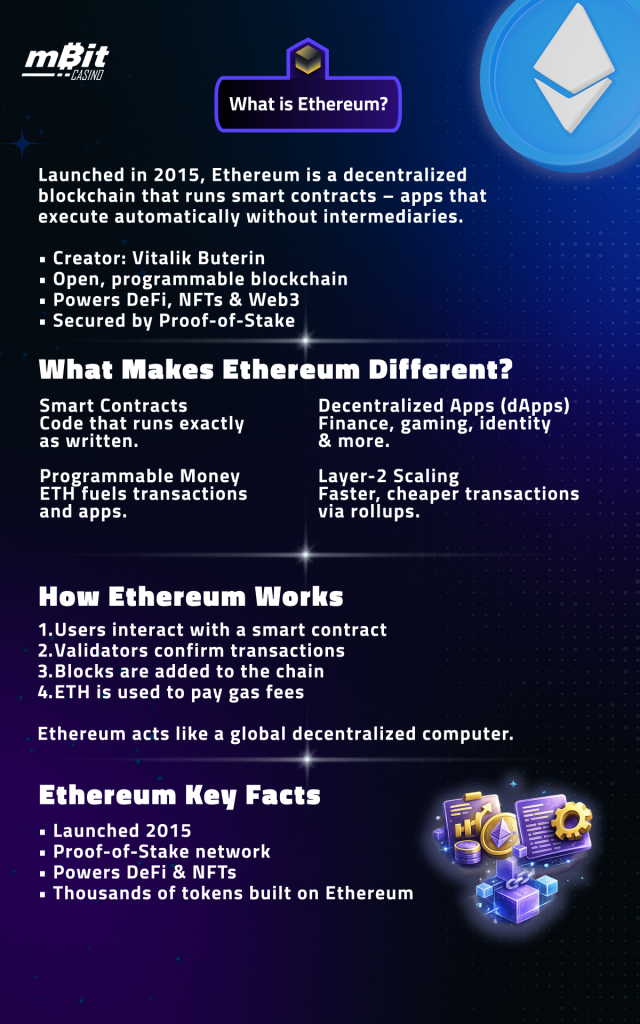
What is Ethereum? Ethereum is a smart contract-based blockchain network that has its own cryptocurrency, Ether. It is also the platform for many other cryptos.
When Vitalik Buterin and his team of co-founders launched Ethereum in 2015, they became more than just competitors to Bitcoin. Instead, the team showed the world that blockchain technology has more to offer than just a decentralized payment method and a digital store of value. By introducing programmable logic and self-executing smart contracts that complete automatically, Ethereum showcased the true potential of blockchain tech.
Fueled by the cryptocurrency Ether (ETH), the Ethereum blockchain opened the doors to a range of decentralized applications, from finance (DeFi) platforms and NFT marketplaces to blockchain gaming and the decentralized internet (Web3), which continues to grow into its own ecosystem.
Understanding What is Ethereum can help you navigate the vast landscape of cryptocurrency and blockchain technology.
What Makes Ethereum Different?
There are several reasons Ethereum is different, and not just compared to Bitcoin, but also to most other blockchains. Let’s take a look at some of the most important.
Smart Contracts
The idea of smart contracts actually predates Bitcoin and blockchain technology, but it was Ethereum that finally brought the idea to life. These programs, which allow for the creation of tamper-resistant contracts that complete automatically when pre-defined conditions have been met. There is no need for a middleman. Think of them like an ATM, taking away the need to speak to a bank clerk when withdrawing funds from your account.
The programmable tech is now enabling blockchain technology across a multitude of use cases in different industry sectors, ranging from real estate to insurance.
Decentralized Applications (dApps)
Using smart contracts, developers are now able to build decentralized applications on the Ethereum blockchain. Called dApps for short, these applications now span a wide range of industries, such as:
- Finance: Lending platforms and decentralized exchanges
- Gaming: Play-to-earn games with true digital ownership
- Identity: Self-sovereign identity solutions that allow users more control over their personal data
- Social media: Censorship-resistant platforms built on a decentralized infrastructure
Programmable Money
ETH isn’t just a store of value; it functions as so much more. As ‘programmable money’, it powers transactions, pays for computation and fuels the dApps built on its network. For every action performed on the Ethereum blockchain, whether that’s transferring tokens or executing complex DeFi strategies, a small fee, known as a gas fee, is required.
Layer-2 Scaling Solutions
Even though the above are all massive accomplishments, arguably the biggest in Ethereum’s ecosystem is the rise of Layer-2 scaling solutions. These are separate networks built on top of the blockchain that process transactions away from it, before returning to it to settle them.
Rollups, which are the most well-known form of L2 tech, are known to bundle hundreds of transactions together before submitting them as a single transaction on Ethereum’s base layer. As a result, transactions are faster and cheaper, while still inheriting the security afforded by the main network.
How Ethereum Works
To understand how Ethereum works, it’s best to start by getting to grips with the basic flow of an Ethereum transaction:
- A user interacts with a smart contract: This could be anything from swapping tokens on a decentralized exchange to minting an NFT.
- Validators confirm the transaction: Instead of miners competing via the proof of work system used by Bitcoin and other blockchains, Ethereum’s proof-of-stake validators are selected to verify transactions based on the amount of ETH they have staked.
- ETH is used to pay gas fees: A gas fee is required for every transaction, which is shared between all validators involved in the transaction.
Essentially, Ethereum operates similarly to a global, decentralized computer. It isn’t owned or controlled by a single entity but is capable of processing millions of transactions and hosting thousands of applications.
What Is The Ethereum Merge?
One of the most notable upgrades Ethereum has made to its blockchain, and arguably one of the most significant in blockchain history, was the network’s change to a proof-of-work (PoW) consensus mechanism. The switch was made from the previous proof-of-stake (PoS), which was a far more energy-intensive mining process.
A quick read-up on the switch will tell you its impact was swift and successful. According to the Ethereum Foundation, the network’s energy consumption was reduced by a mind-boggling 99.95%. Effectively, the blockchain went from consuming roughly 23 megawatt-hours of electricity to just over 2,600. As you can imagine, it was a transformation that took away one of the main criticisms of blockchain technology.
Under proof-of-stake, validators secure the network by locking up (or staking) their ETH rather than running power-hungry mining hardware. This makes participation more accessible and far more sustainable.
Ethereum Key Facts
- Ethereum Launch date: The Ethereum blockchain officially launched on July 30, 2015.
- Consensus mechanism: Has been Proof-of-Stake since September 2022.
- Primary use cases: DeFi, NFTs, dApps, tokenized assets.
- Native token: Ether (ETH). It is the second-largest cryptocurrency by market cap behind Bitcoin.
- Ecosystem scale: Thousands of tokens and applications are built on Ethereum.
- Major 2025 upgrades: Pectra launched in May and Fusaka in December, both of which improved validator flexibility, account abstraction and Layer-2 data throughput.
Frequently Asked Questions About Ethereum
What is the difference between Ethereum and Ether (ETH)?
Although it may seem confusing to crypto newcomers, Ethereum is the blockchain, and ETH is the cryptocurrency that runs on top of it.
What Are Ethereum Gas Fees?
As with any cryptocurrency, users have to pay fees when making transactions. They’re usually lower than most fiat currency transactions and are often no more than just a tiny fraction of the transaction itself. Using Ethereum, these fees are known as gas fees.
What are smart contracts in simple terms?
A smart contract is a program on the blockchain that allows for a conclusion to be met once any predefined conditions have been met. The easiest way to explain them would be to compare them to a vending machine. You simply drop your coins in, and you receive the product, doing away with the need for a cashier.
Is Ethereum environmentally friendly?
It hasn’t always been, but ever since The Merge in 2022, which saw Ethereum switch to a Proof of Stake consensus mechanism, it certainly is now. That move reduced energy consumption by 99.95%, which is a crazy figure when you think about it.
What are Layer-2 solutions, and why do they matter?
Layer-2 solutions are networks built on top of Ethereum that handle transactions away from the main blockchain. The solution ensures reduced congestion and lower costs.
How does Ethereum’s proof-of-stake work?
Selected randomly, validators stake a minimum of 32 ETH to participate in securing the network. As long as they act honestly, they’ll get rewarded. However, if they’re found to be attempting to game the system, they’ll lose a portion of their ETh as punishment.
Can Ethereum be used for more than cryptocurrency?
Ethereum was arguably the first cryptocurrency that showed blockchain technology could be so much more than a decentralized payment gateway. Just a few world examples of Ethereum include NFT marketplaces, supply chain tracking systems, voting mechanisms, gaming ecosystems and even tokenized real-world assets like government bonds and real estate.
What risks should I be aware of with Ethereum?
Ethereum carries the same risk you’ll have with most cryptocurrencies, but also a few specific to the crypto. For instance, smart contract bugs can lead to vulnerabilities, and gas fees can spike during periods of heavy network activi