

BNB (Binance Coin) is the native cryptocurrency of Binance, one of the largest crypto exchanges online today. The exchange launched in 2017 alongside its BNB crypto asset, which initially began as an ERC-20 token on the Ethereum blockchain. With the exchange’s growth, its BNB token has also evolved. Since 2019, BNB has undergone a token swap after Binance created its own blockchain ecosystem, now known as the BNB Chain.
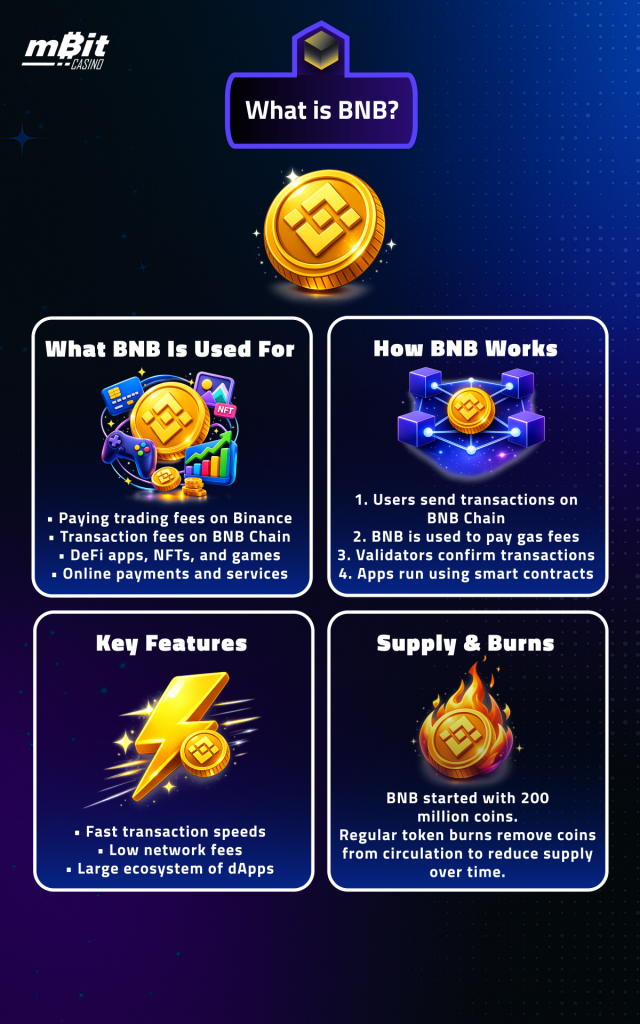
Our infographic breaks down the BNB Chain into four core areas to help you understand how it works. To accompany this, we provide a full explanation covering BNB, so by the end of this article, you can connect the dots and understand the engine behind the BNB Chain.
What BNB Is Used For (And What That Means for You)
Each BNB token on the BNB blockchain ecosystem wraps transactions and ensures they are processed using smart contracts. That means if you use a DeFi app, trade NFTs, trade crypto, or play games that require smart contracts, it is the BNB tokens that initiate the transaction and carry it through until the contract conditions are met and the transaction can be closed. In short, BNB keeps all on-chain actions moving.
The main uses for BNB:
- Wallet to Wallet
- Crypto Trading
- Online Gaming Payments
- Online Shopping Payments
- DeFi and NFTs
As you can see, BNB is popularly used as a payment method, mostly in the gaming niche. Online crypto casinos often accept BNB because of the exchange’s popularity and BNB Chain features, such as low transaction fees and fast settlement times. In particular, these features are especially suited to casino players who want instant deposits and withdrawals.
How BNB Works (And Why It’s Built This Way)
All BNB transactions use the BNB Chain using two key processes. The first are simple wallet-to-wallet transactions, such as depositing from your crypto wallet to an online gaming site or making online payments. The second is when DeFi apps and NFTs use BNB smart contracts.
How Wallet-to-wallet Transactions Work
When making a transfer to another BNB wallet address, you can either scan the 2D code or enter the destination wallet address. This is typically a 42-character address that looks like this – 0x8ba1f109551bD432803012645Ac136ddd64DBA72. Once you confirm the transaction, it is broadcast on the BNB Chain. Validators will then verify the transaction’s legitimacy and log it on the blockchain.
How Smart Contract Transactions Work
Smart contracts already exist on the BNB Chain. You’ll use them when you process a transaction that requires your wallet to interact with one of them. For example, DeFi or NFT transactions. The contract contains predefined rules, and if those conditions are met, the transaction is automatically executed. As with all BNB transactions, validators confirm and record the result on the blockchain.
BNB Gas Fees
A small portion of your transaction is used to pay gas fees, which is similar to Ethereum. One of the key factors that make BNB an attractive option, especially compared to ETH, is its low fees and fast transaction settlement times.
- Simple transfers (wallet to wallet): $0.05 to $0.10 USD
- More complex transactions (DeFi, NFTs): $0.10 to $0.30+ USD
You will pay the gas fees separately from your wallet balance. For example, if you send $100 USD in BNB, the receiver will receive the full $100, while the fee for the transaction will be taken from your remaining wallet balance.
BNB Price Movements
The advantage of BNB’s use case is that it is not a crypto valued purely on speculation. Its main price driver is demand, so when BNB is trending, its market price tends to rise. However, if BNB usage declines, the downside for BNB investors is a drop in BNB’s value. As a result, its use case is different from Bitcoin, which today is mostly used as a store of value.
Where BNB Stands Out
BNB stands out because of its connection with one of the world’s largest crypto exchanges. As a means of digital monetary exchange, its standout features are low network fees and fast transaction speeds. On top of this, it has a huge dApp ecosystem, which attracts a wide range of applications, from DeFi platforms to gaming and online payments.
People often use BNB for the following reasons:
- Used for Regular Transactions: Low fees mean that if you regularly transact using crypto, stacked fees via the BNB chain are kept low.
- Used for Crypto Trading: BNB is widely used on exchanges, where it can reduce trading fees and improve efficiency when moving between assets.
- Used for dApps: The BNB Chain is home to a huge network of DeFi platforms, games, and online services, thanks to its fast transaction times, which help avoid delays.
- Used for Fast Transaction Processing: Fast settlement times make BNB suitable for activities like online gaming and payments, where users want quick deposits and withdrawals.
Supply and Token Burns (Why Scarcity Is Built In)
Every three months, the Binance Chain burns BNB tokens. The idea is to reduce the number of tokens in supply. With fewer tokens in circulation, the idea is to create scarcity, and so when demand for BNB is high, the value of each token should increase.
The scarcity strategy is similar to Bitcoin, but it works differently. Bitcoin has a fixed supply of 21 million, and once all BTC has been mined,d there will be no more, thus creating scarcity. On the other hand, BNB burns coins to reduce its supply to create scarcity. Both heavily rely on high demand to create this scarcity, which in turn should mean the price of each BTC or BNB goes up, which usually creates more demand.
For BNB, its BNB Chain undergoes a token burn over 3 months, removing a random number of tokens from circulation. The burn does not always result in price gains, but as the ecosystem continues to burn tokens, BNB has a higher chance of increasing in value each time the crypto market enters a new bull run.
Where BNB Fits Compared to Other Cryptocurrencies
BNB has its own place in the crypto sphere, and to understand where it fits, we’ve chosen to compare it with ETH and BTC. Naturally, it makes sense to make comparisons to see which one suits our personal goals. That’s the beauty of cryptos. There are so many of them, and each one offers something slightly different.
BNB Vs Bitcoin
BNB is not trying to compete with the likes of Bitcoin, which today is mostly known as a store of value, hence the nickname ‘digital gold’. On the other hand, BNB focuses more on usage rather than store of value. In comparison, BTC can take up to 20 minutes to process transactions, whereas BNB can process transactions in seconds.
Fees are also around $1 to $10 USD using BTC versus $0.05 to $0.30 USD on the BNB Chain. However, one area to consider when comparing the BNB Chain and Bitcoin ecosystems is that BTC transactions rely more heavily on a larger number of nodes to validate transactions, making it more decentralized than BNB.
BNB Vs Ethereum
However, its ecosystem overlaps with Ethereum, which makes sense since BNB originally launched as an ERC-20 token. Its similarities with Ethereum include smart contracts and a large dApp ecosystem. In terms of usage, BNB offers faster transaction speeds at a lower cost than ETH. We’re talking seconds versus minutes.
Both systems also use gas fees, and while BNB’s fees are low and predictable, the same cannot be said of Ether. Its fees are unpredictable as the network regularly becomes congested, which in turn results in higher gas fees.
Which to Choose?
The trade-off for BNB is that its ecosystem doesn’t rely as heavily on decentralization as Bitcoin or Ethereum. Its store of value is also not as high as that of BTC or ETH. Consequently, BNB is a viable crypto if you are looking for speed and low fees, but you are not overly concerned by store of value or decentralization.
Why BNB Remains Popular
BNB remains popular thanks to its fast transaction times and low cost. It also gains trust because it is backed by one of the world’s largest crypto exchanges. In the dApp and NFT niche, especially on the Binance exchange and wallet options, the Binance Chain continues to remain busy serving gamers, DeFi and NFT collectors.
FAQs
What does BNB stand for?
It stands for Build and Build, or Build ‘n’ Build as some refer to it. The name changed when the token shifted from being an ERC-20 token to a native coin on the newly created Binance Chain ecosystem.
Why do you need BNB to use the network?
The BNB token is the cryptocurrency that powers the Binance Chain. Holders use it to make payments and receive funds, and to interact with apps and NFTs.
Is BNB only useful on Binance?
No. BNB has become a mainstream crypto that many wallets and other exchanges feature. It is also used by an increasingly large number of decentralized apps. As a result, BNB is not just tied to the Binance exchange.
How do BNB token burns affect you?
If you hold BNB, then theoretically, when tokens are burned to reduce supply, the price of each token should increase. However, that is not always the case, as the system also relies heavily on demand, i.e., crypto users and apps using BNB.
Is BNB faster than Ethereum?
Yes, typically it is considerably faster than Ethereum. BNB has a 3-second block time, giving you confirmations in mere seconds. ETH has a 12-second block time, and its ecosystem often suffers from congestion, so confirmations can take 30 seconds to a couple of minutes.
Can you use BNB for payments?
Yes, you can make payments using the Binance exchange’s self-custody and custodial wallets. It is also supported by MetaMask, TrustWallet, Crypto.com, and other wallets. Major exchanges like Kraken, KuCoin, Gate.io, Bybit and Coinbase also support BNB, depending on your region.
What makes BNB different from Bitcoin?
Bitcoin is mainly used as a store of value, while BNB is designed for utility and regular use. Additionally, BNB settles transactions more quickly at a fraction of the cost. On the flip side, Bitcoin’s decentralization is stronger than BNB’s.
Does BNB depend on Binance?
They are linked as it is easy enough to associate the Binance Exchange with the Binance Chain. However, BNB does not depend on the exchange to operate as it has its own blockchain ecosystem.
Is BNB deflationary?
Yes. The supply continues to decrease as the Binance Chain burns tokens every quarter. On top of this, coins are also burnt in real time. The number of tokens burnt is always different, but the long-term goal is to reduce the supply to 100 million BNB.