


Cryptocurrencies didn’t appear overnight. What began as an idea for digital cash, when Satoshi Nakamoto published Bitcoin’s whitepaper in 2008 and released the first BTC in 2009, has now become a global financial ecosystem worth trillions.
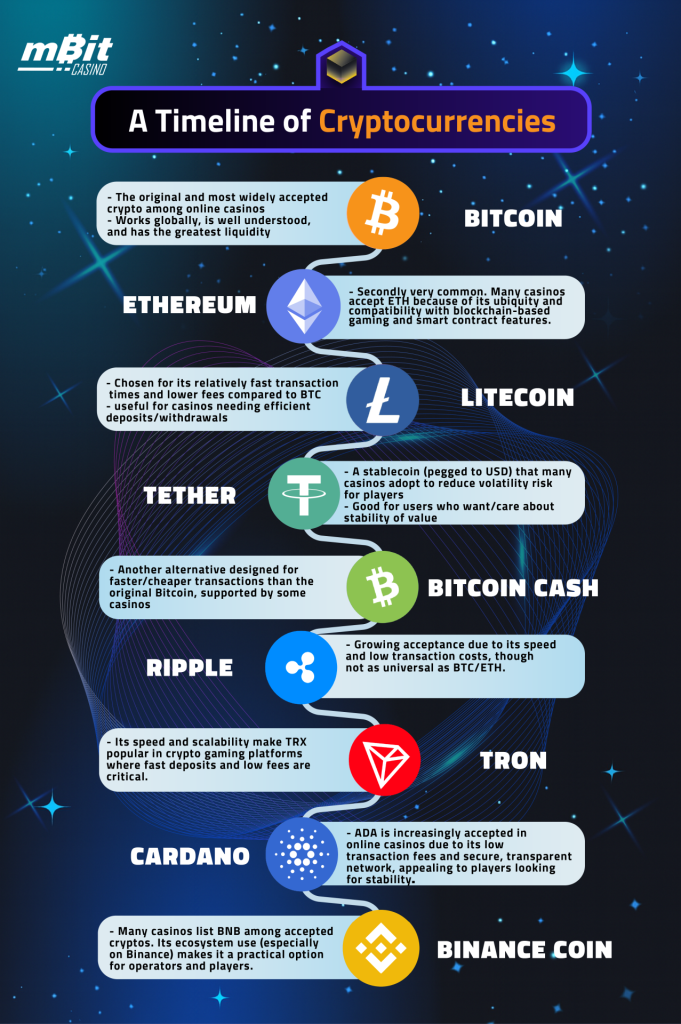
To help you understand the journey cryptocurrencies have taken, we put the evolution of what is now nicknamed ‘digital gold’ into chronological order and examine how big players such as Litecoin, Bitcoin Cash, Ripple (XRP), TRON, Cardano, and Binance Coin became high-profile crypto coins.
The 2008 Financial Crisis – A Perfect Backdrop
2008 is widely recognized as a catalyst for the creation of cryptocurrencies. There’s always been some level of distrust toward traditional financial systems, and when the truth behind the 2008 financial crash became mainstream media, trust hit rock bottom.
People lost faith in the financial system, public trust hit rock bottom, creating the perfect environment and backdrop for change, which led to the creation of Bitcoin and the era of digital gold.
The Birth of Satoshi Nakamoto’s Bitcoin
Bitcoin was born in 2009. Developed by an individual or group under the pseudonym Satoshi Nakamoto, the world’s first cryptocurrency began to redefine digital finance through what we now know as blockchain technology.
The idea of Bitcoin was revolutionary, as it cut out the middleman, reducing transaction costs and speeding up transactions by eliminating red tape. A few early adopters saw the value of what we now call decentralized financial technology. Since the birth of BTC, holders of the crypto have been able to send transactions without relying on a centralized authority, and the concept has quickly spread.
First Real-World Bitcoin Transaction (Bitcoin Pizza Day)
One of the most famous, as well as one of the most surreal milestones in Bitcoin’s early history, was its first recorded real-world transaction. Now supported annually by crypto enthusiasts who know their history, as Bitcoin Pizza Day, it involved the purchase of pizza.
This happened on May 22, 2010, when programmer Laszlo Hanyecz paid 10,000 BTC for two pizzas. While that sounds like an extremely expensive pizza at today’s BTC price, back then the coins had a combined value of around $41. Today, you’d be talking about hundreds of millions, which just shows how the price has soared over the years.
Bitcoin as the Foundation of the Crypto Ecosystem
Rightly so, Bitcoin is widely regarded as the foundation of the entire cryptocurrency ecosystem. It was the first digital currency to introduce the concept of decentralized transactions that used cryptographic proof rather than financial intermediaries to secure them.
In fact, it remains the benchmark in the industry. Even today, the price swings of Bitcoin influence the broader crypto market. Whether it increases or drops, the price of most other cryptos will follow suit.
The Second Generation – Smart Contracts and Ethereum
Ethereum became the first of thousands of other crypto projects to follow Bitcoin. Founded by Vitalik Buterin, Ethereum introduced numerous innovations, starting with smart contracts, which are programmable agreements that execute automatically when conditions are met.
Ethereum vs. Ether – Understanding the Difference
A common point of confusion, is the distinction between Ethereum and Ether and what they do. Ethereum is the blockchain network, the decentralized platform that runs the project’s smart contracts and dApps. As for Ether or ETH, it is the native cryptocurrency of that platform. In short, Ethereum is the infrastructure and Ether is the fuel that powers it.
How Ethereum has Contributed to the Evolution of Blockchain Tech
Essentially, Ethereum showed that blockchain tech could become more than just about payments. It could become a platform, much like the project achieved through key innovations, including smart contracts, decentralized applications (dApps): and token creation frameworks.
As a result, Ethereum dramatically expanded what blockchain technology could do. It paved the way for much of what we see today, such as: Decentralized Finance (DeFi), NFTs, Web3 ecosystems.
By expanding blockchain tech into a programmable platform and moving it forward from just a payment method, Ethereum became responsible for the second generation of crypto innovation. Developers were now able to build their own economies, applications and communities using the tech.
Early Altcoins – Litecoin and the Push for Faster Transactions
Ethereum was just the first of thousands of altcoins, a name given to cryptocurrencies other than Bitcoin, to make their mark. Of those that quickly followed, Litecoin, founded by Charlie Lee, was created to address some of the limitations of Bitcoin by offering:
- Faster block generation
- Lower transaction costs
- Modified hashing algorithms
Litecoin quickly became known as the Silver to Bitcoin’s digital Gold, showing that cryptocurrencies were now doing more than just copying Bitcoin; they were entering the scene with their own ideas.
The Scaling Debate – Bitcoin Cash and Blockchain Forks
Although Bitcoin’s popularity was souring, by 2017 several technical challenges emerged. The blockchain’s transaction fees slowed and then began to increase consistently. The core issue was the blockchain’s block size limit, capped at 1MB. They had become a bottleneck because each block could only accommodate a limited number of transactions. Users essentially had to compete for faster transactions by paying higher fees.
This led to a split in the community on how to scale the network, with the eventual solution being to create a blockchain fork, Bitcoin Cash. With increased block sizes that enabled higher transaction output, Bitcoin Cash arrived in 2017.
Enterprise and Payment-Focused Cryptos – Ripple and Tron
As Litecoin had shown, not every new crypto project was designed to follow Bitcoin’s blueprint. An example is the stance taken by the likes of Ripple and Tron. Instead of following the early narratives of cryptocurrencies, such as rebelling against traditional payments, these were designed to integrate with them rather than attempt to disrupt them.
- Ripple (XRP): Ripple entered the scene with the aim of benefiting banks and financial institutions. The idea is to improve cross-border payments, which have long been criticized for being slow, expensive, and inefficient. In short, the emphasis wasn’t on replacing banks, but on working alongside them. It didn’t take long for Ripple to earn a reputation for forging partnerships with financial institutions, demonstrating that blockchain technology could coexist with traditional systems.
- TRON (TRX): TRON took things in a different direction altogether. While other projects focused on competing with Bitcoin and others created purely for payments, the Justin Sun-founded project targeted the digital content and entertainment sector, aiming to reshape how creators distribute and monetize media. The network shone due to providing higher throughput and lower transaction costs thanks to its unique Delegated Proof-of-Stake (DPoS) consensus model. It was the perfect solution for those who wanted to process frequent interactions and microtransactions.
Following Ethereum’s demonstration of the true potential of blockchain technology, many more networks emerged, though now with specialized goals. Solana, for instance, focused on scalability and performance, making it popular for DeFi platforms and NFT marketplaces.
Research-Driven Blockchains – Cardano
Cardano is a more recent altcoin, but one that is already making its mark in the blockchain space. Founded by Charles Hoskinson, it became the first blockchain built through a scientific, peer-reviewed academic approach and cryptographic research.
While most ecosystems were built by people who just started coding and then fixed problems as they went along, experts studied ideas and checked the math to make sure everything would work as intended from the get-go.
The Exchange Era – Binance Coin and Platform Tokens
Even cryptocurrency exchanges started getting in on the act. Not content with supporting the trade of digital currencies, the likes of Binance began issuing their own coins.
Binance Coin (BNB) was initially created as a utility token that users could use to pay transaction fees on the Binance exchange platform, effectively receiving discounts. However, like other cryptocurrencies, it evolved into much more, becoming an ecosystem that could support payments, trading, and decentralized applications.
Binance was not alone, as other exchanges soon followed suit with their own cryptocurrencies. Examples include Crypto.com, which introduced the CRO token and Kucoin with its KCS coin. As with BNB, these coins typically offer benefits such as reduced fees and staking rewards.
The Modern Crypto Landscape
Anyone who was around and involved in the cryptocurrency space from the very beginning will tell you that what you see today barely resembles the early days of Bitcoin. What began as nothing more than an experimental foray into digital payments has now become a vast and highly diversified ecosystem.
Go to a cryptocurrency exchange, and you’ll find thousands upon thousands of different digital assets.
Regulation and Mainstream Adoption
What initially started out as largely unregulated, cryptocurrencies are now facing increasing oversight. Governments and financial authorities are trying to add taxation models and create legal frameworks. Whatever your thoughts on that, it at least shows how far crypto has come from its early days of Bitcoin and Ethereum.
Institutional Investment
Showcasing the general confidence in the tech, major corporations and financial institutions have also increasingly engaged with blockchain projects. BlackRock and Fidelity have introduced digital asset investment products, while the likes of Goldman Sachs and JPMorgan have also entered the blockchain-powered space.
Final Thoughts – From Experiment to Ecosystem
Looking back, it’s clear that cryptocurrency began life as nothing more than a bold experiment. Bitcoin burst onto the scene with the aim of challenging traditional banking methods by delivering a decentralized currency that could be used without the interference of banks or other financial institutions.
Ethereum soon followed, demonstrating that blockchain tech could power platforms and ecosystems rather than just serve as a decentralized way to send money. Other altcoins continued the evolution, pushing the space even further. Some, like Solana, focused on improving speed and costs, while others, such as Ripple, used their tech to enhance traditional payments.
In short, modern crypto is no longer just about digital currency. It is now forcing its way into finance, infrastructure, entertainment and so many other areas. Moreover, it’s still evolving, and history is still being written. While the focus will understandably remain on where cryptocurrencies take us in the future, it’s just as important to remember where it all started.