
When blockchain technology first emerged to provide a decentralized system for transferring digital money, it has not remained the same. Over the years, it has evolved through several generations, with each bringing it closer to the multi-layered ecosystems we benefit from today. It now powers finance, applications, governance and scalable infrastructure.
As the technology, which will continue to develop, has passed through the generations we discuss in this article, the limitations of the previous ones have been addressed.
Generation 1 – The Birth of the Blockchain
While it might seem that blockchain technology was a sudden inspiration or idea that was first put in place with Bitcoin, its concept and early building blocks were put in place decades prior. In fact, we can go back as far as the 1980s to see the early ideas of the technology being put together.
What’s sad is that many of the researchers and computer scientists responsible for these early building blocks will never get the recognition they deserve. Throughout the years, these people had been looking at different ways they could create a decentralized way to store information, verify records and share data across networks without the oversight of a central authority.
Several foundational technologies played a role. Systems were created that are a big part of blockchain technology today, including those developed to record when data was created, encryption methods securing information, and to share databases across a network of computers. Even the early form of Smart Contracts, which are self-executing agreements powered by code, were already being worked on.
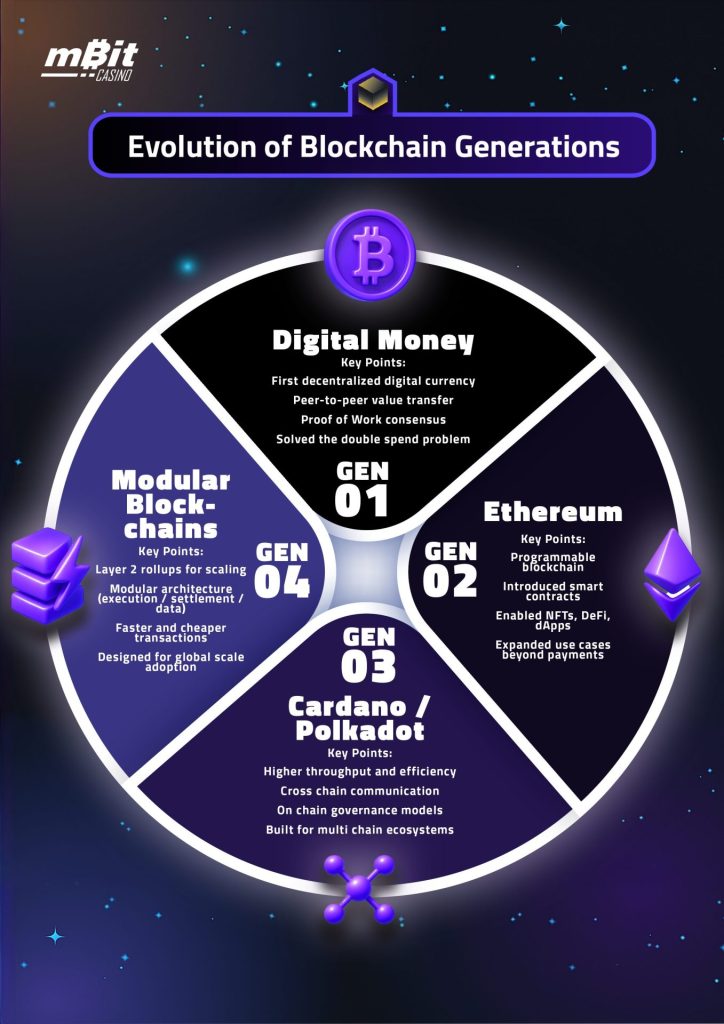
Generation 2 – Bitcoin and the Start of Digital Money
Blockchain technology and cryptocurrencies became more than just a concept in 2011 with the launch of Bitcoin. People were now able to send and receive money without the interference of banks and financial institutions. As we know, the idea caught on very quickly, mainly due to the decentralized nature of these transactions, allowing people to stick their fingers up at traditional systems.
However, early blockchain technology came with many limitations. It was merely a payment gateway and nothing more. The technology:
- Lacked scalability
- Had high energy consumption
Fortunately, we didn’t have to wait too long for the technology to start evolving. Exciting new projects emerged that would start to address the issues and bring the technology further. Much of the earliest credit goes to Ethereum, which brought more than just a rival cryptocurrency.
Coming onto the scene in 2015, its version of the blockchain was able to host applications and smart contracts, which are code that automatically enforces rules and conditions. Once a predefined criterion has been met, the contract executes automatically without needing any human input.
Generation 3 – Scalability and Interoperability
The third generation of blockchain technology is where we started to see refinements to what came before. Bitcoin, Ethereum and many other projects had put in place the building blocks, so newer names in the crypto space came in to help refine blockchains rather than attempting to replace them.
Good examples are Cardano and Polkadot, two projects that would look at:
- Increasing transaction throughput
- Lowering network costs
- Improving interoperability
Cardano (ADA) took a research-driven approach. The project aimed to improve sustainability, scalability and stability by prioritizing peer-reviewed development and layered architecture.
Polkadot, (DOT) on the other hand, focused on cross-chain communication. The project introduced a framework where multiple blockchains (parachains) could operate within a shared ecosystem.
Other third-generation innovations included:
- Improved consensus mechanisms – More energy-efficient alternatives to Proof of Work.
- Cross-chain functionality – Enabling networks to exchange information.
- On-chain governance – Built-in decision-making structures.
- Performance optimization – Faster confirmation speeds.
Combined, all of the above were able to resolve many of the earlier blockchain limitations, especially when it comes to speed and fees
Generation 4 – Modular Blockchain Architecture
The fourth generation represents less of a feature upgrade and is more of a design shift. We began to see the development of more modular blockchains. While blockchains previously handled every function internally, newer modular architectures were able to separate responsibilities into different specialized layers.
For example, modular blockchains could separate things like:
- Execution
- Consensus
- Data availability
- Settlement
This gave networks the ability to scale without requiring all nodes to process every transaction.
One of the most widely discussed modular approaches involves Layer 2 scaling solutions, such as rollups. While they still relied on the main blockchain for security and settlement, rollups allowed transactions to be processed outside of it.
This type of modular design brought many advantages, including:
- Scalability – Workloads can be distributed across layers.
- Flexibility – Developers can tailor components to specific needs.
- Reduced congestion – Not every transaction burdens the base layer.
- Customization – Networks can optimize for particular use cases.
Essentially, the fourth generation stopped treating the blockchain as a single system and instead treated it as a technology stack. This shift reflected a growing recognition that to support mainstream applications, the blockchain would have to operate at an internet-sized scale.
Final Thoughts – Where Blockchain Is Headed
It’s certainly clear that blockchain technology has come a long way. What started as a way to move money around without having third parties getting a piece of every transaction and bringing red tape has become a foundation for applications, financial systems and digital infrastructure.
First, the blockchain became more programmable, allowing it to provide many more functions. Following that, it then became faster, more efficient and less resource-hungry. Finally, with modular designs, it is now becoming more flexible and scalable.
It’s important to understand that each generation of technology didn’t replace the previous one, it built on it. That is what is likely to continue with each newer generation coming our way. As adoption continues, there’s no doubt there will be new challenges, but blockchains will continue to adapt to eliminate them, just as they have before.